
Domain 6 — Implement guardrails and accountability — is 10–15% of the exam. Small by weight, but it carries the philosophy the whole exam is built on: maximum safe velocity. Every other domain’s “secure answer” is really a Domain 6 instinct. Master this and you sharpen your answers everywhere.
The exact skills measured in Domain 6:
- Define autonomy levels — classify actions by operational, security, and compliance risk to right-size human interventions; assign autonomy levels that maximize delivery speed while staying compliant with security and Responsible AI standards.
- Implement guardrails and human-in-the-loop workflows — identify actions needing human judgment; block actions violating security/compliance/Responsible AI policy; scope permissions and execution contexts to least privilege; require explicit authorization for irreversible or compliance-sensitive changes; preserve velocity by minimizing approvals that don’t materially reduce risk.
The core principle: maximize safe velocity
Read the objective language carefully — it appears twice: maximize delivery speed while remaining compliant and preserve execution velocity by minimizing approvals that do not materially reduce risk.
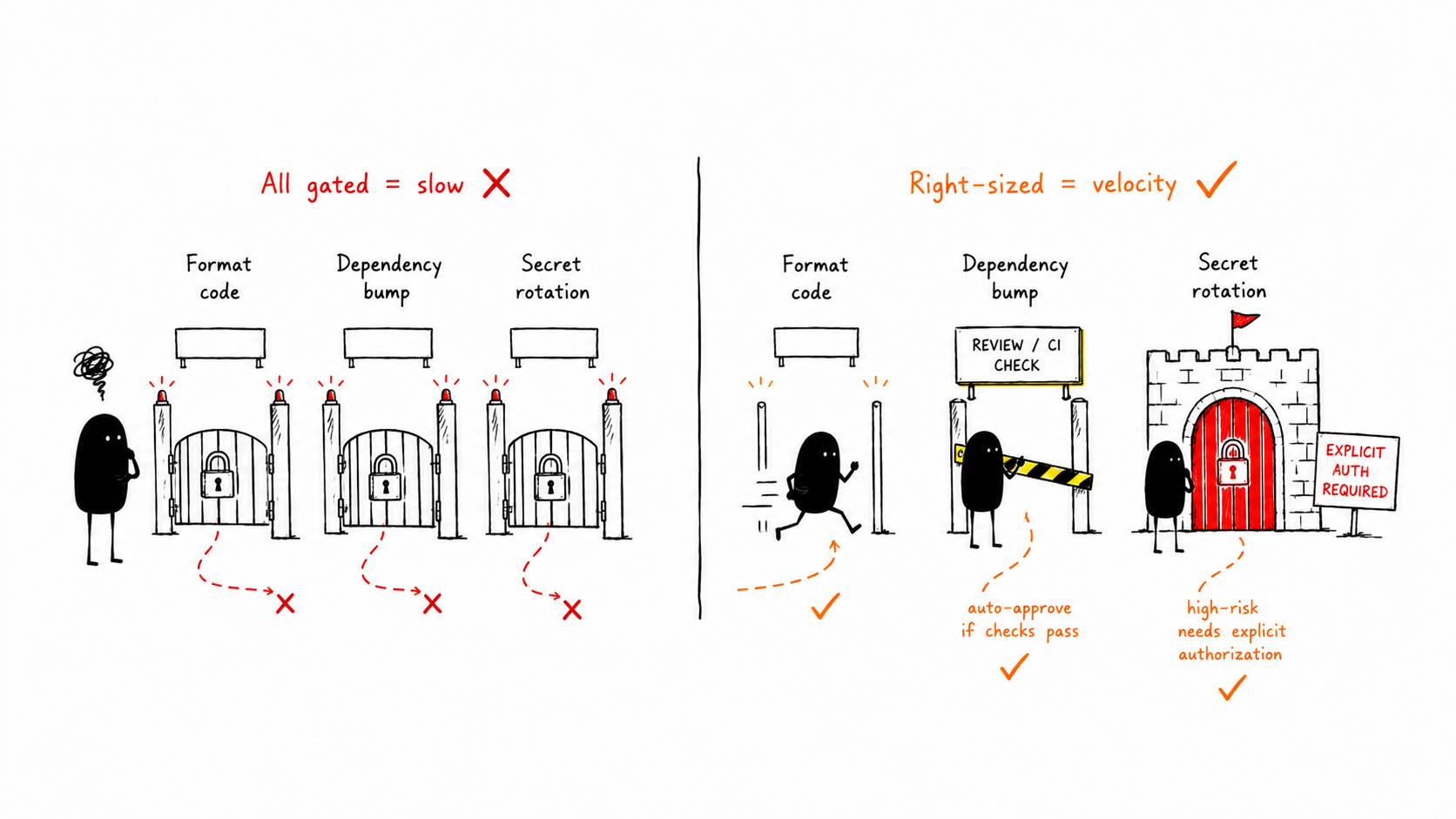
GH-600 is not asking you to lock everything down. It is asking you to put friction exactly where risk is, and nowhere else. Two equal-and-opposite wrong answers:
- Over-gating — approval on every action. Compliant but slow; defeats the agent’s purpose.
- Under-gating — no checks on risky actions. Fast but unsafe; one bad run does real damage.
The right answer is almost always the option that gates the high-risk action and lets the low-risk ones flow.
Classifying actions by risk
You cannot right-size autonomy without first classifying the action. Three risk lenses from the objective:
| Lens | Question |
|---|---|
| Operational | If this goes wrong, what breaks? How big is the blast radius? Reversible? |
| Security | Does it touch secrets, permissions, auth, or production access? |
| Compliance | Does it touch regulated data or controlled processes; is an audit trail required? |
Run any agent action through these and you get its risk tier:
| Risk tier | Example actions | Right-sized control |
|---|---|---|
| Low | Read a file, add a label, format code, open a draft PR | Autonomous; review after via artifacts |
| Medium | Merge to a feature branch, modify non-critical code | Required review/CI; auto-proceed on green |
| High / irreversible | Push to main, deploy, rotate a secret, delete data, change permissions | Explicit human authorization, controlled path |
Scenario — right-sizing. An agent’s task list: (1) reformat code, (2) update a dependency, (3) deploy to production. Correct guardrail design: 1 runs autonomously; 2 opens a PR with scans and merges on green review; 3 requires explicit human authorization through a controlled release path. Same agent, three different gates, each matched to risk. Gating all three equally — or none — is the wrong answer.
Human-in-the-loop where judgment is needed
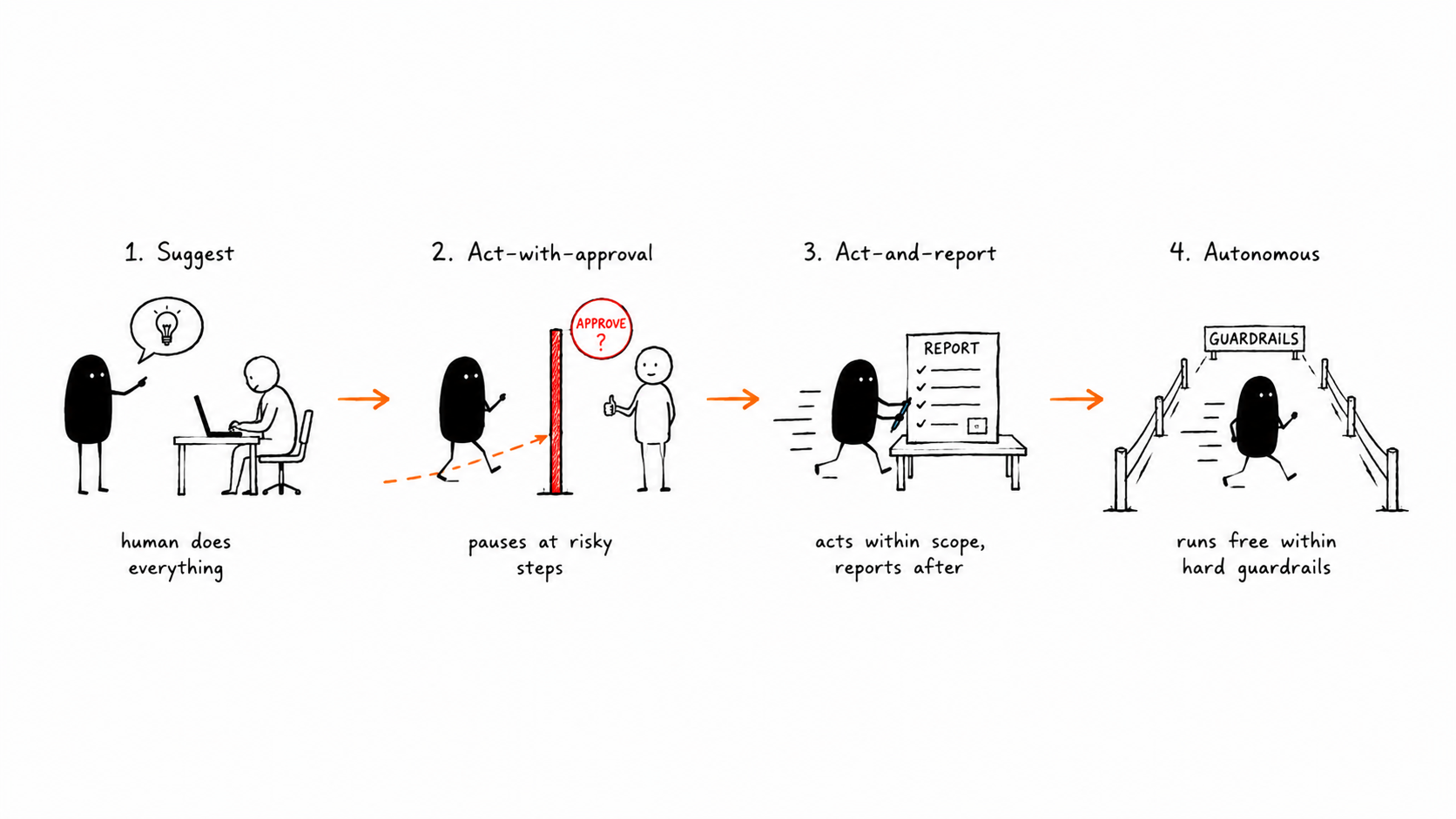
The skill is identify the subset of actions that require human judgment — not “add a human everywhere.” Human-in-the-loop belongs where:
- The action is irreversible (deploy, delete, rotate).
- It is compliance-sensitive (regulated data, audited change).
- The agent’s confidence is low or it hit ambiguity (escalation from Domain 2).
- It crosses a policy boundary that requires accountable sign-off.
Everywhere else, let the agent run and review via artifacts. The exam phrasing to internalize: minimize approvals that do not materially reduce risk.
Blocking policy-violating actions
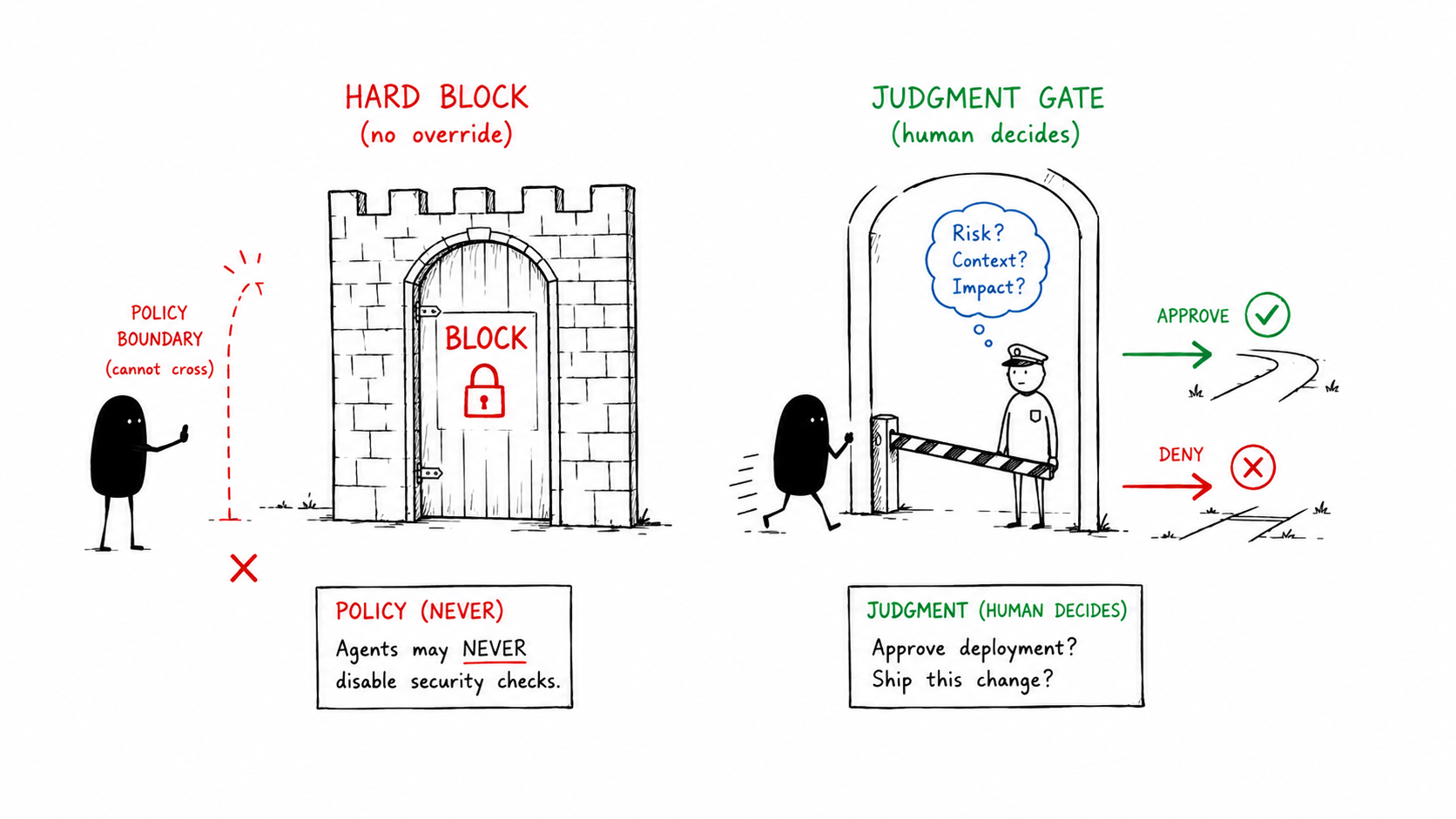
Some actions shouldn’t be approved — they should be blocked outright. Domain 6 wants guardrails that prevent actions violating security, compliance, or Responsible AI policy, regardless of approval.
| Mechanism (GitHub) | Blocks |
|---|---|
| Branch protection / rulesets | Unauthorized merges to protected branches |
| Required reviews/checks | Unreviewed/failing changes reaching main |
| Scoped permissions / least privilege | Actions outside the agent’s granted scope |
| Plan validation (Domain 1) | Plans that target forbidden paths/actions |
| Allow lists (Domain 2) | Use of disallowed tools/MCP servers |
Block vs. approve — a key distinction. “Requires approval” means a human can say yes. “Blocked by policy” means it cannot happen at all (e.g. an agent may never exfiltrate secrets or disable a security control). High-judgment-but-permitted → human-in-the-loop. Never-permitted → hard block. The exam tests that you don’t turn a hard policy into a mere approval prompt.
Least privilege and scoped execution
Straight from the objective: scope permissions and execution contexts to enforce least-privilege access. This is the same instinct as Domain 2’s tool permissions, applied to the whole execution context:
- The agent gets the minimum permissions for the task — no standing broad tokens.
- Its execution context is bounded — scoped repo, branch, environment.
- Capabilities it doesn’t need, it doesn’t have.
Least privilege is the cheapest guardrail: it shrinks blast radius before anything goes wrong, with no per-action approval cost.
Authorization for irreversible changes
Require explicit authorization or controlled paths for irreversible or compliance-sensitive changes. Irreversible/sensitive actions must go through a deliberate gate:
- Explicit authorization — a named human approves, on the record.
- Controlled path — the change can only happen through a defined, audited route (a release pipeline with sign-off), never ad hoc.
Scenario — irreversible action. An agent determines a database migration is needed. It must not run it autonomously. The compliant design routes the migration through a controlled path requiring explicit human authorization, with the decision recorded. Reversible prep (writing the migration, opening the PR) is autonomous; executing it is gated.
Accountability and the audit trail
”Accountability” is in the domain name for a reason. Every agent action must be attributable and recorded — which agent, what it did, under what authorization. GitHub gives this for free: commits, PRs, reviews, Actions logs, the audit log. The guardrail design isn’t complete until you can answer “who/what did this, and who authorized it?” for any action.
Exam-style check
Q1. An agent’s tasks are: format code, bump a dependency, and rotate a production secret. How should autonomy be assigned?
A. Format → autonomous; dependency bump → PR + review/CI, auto on green; secret rotation → explicit human authorization via a controlled path. Right-size per risk.
Q2. Policy says agents may never disable a security check. Is that an approval gate or a block?
A. A hard block — it must be impossible, not merely approvable. Don’t downgrade a policy prohibition to an approval prompt.
Q3. What’s wrong with requiring human approval on every agent action “to be safe”?
A. It adds approvals that don’t materially reduce risk and destroys velocity. Domain 6 wants friction only where real risk is.
Q4. Cheapest guardrail to shrink an agent’s blast radius before anything happens?
A. Least-privilege scoping of permissions and execution context — no standing broad access, bounded repo/branch/environment.
Q5. An agent needs to run an irreversible data migration. Compliant design?
A. Autonomous to prepare (write/PR the migration); explicit human authorization through a controlled, audited path to execute.
What to memorize
- The whole exam’s spine: maximize safe velocity — gate risk, free everything else.
- Classify actions by operational / security / compliance risk, then assign autonomy.
- Human-in-the-loop for irreversible, compliance-sensitive, low-confidence, or policy-boundary actions only.
- Block policy-violating actions outright; don’t reduce a prohibition to an approval.
- Least-privilege scope = cheap, pre-emptive blast-radius control.
- Irreversible/sensitive → explicit authorization + controlled path, all attributable in the audit trail.
Last module: the exam-day first-attempt playbook.