
Before any domain makes sense, you need one clean mental model: what an agent is, how it differs from an assistant, and why putting it inside an SDLC changes everything about safety and accountability. GH-600 tests this model indirectly in every question.
Assistant vs. agent
An assistant responds. You ask, it answers, you act. The human is in the loop on every step. Copilot autocomplete and chat are assistants — they suggest, you decide.
An agent acts. Given a goal, it plans, takes actions in the world (edits files, runs commands, opens PRs), observes the result, and decides what to do next — with reduced human involvement per step. The GitHub Copilot coding agent is an agent: you hand it an issue, it works in its own environment and comes back with a pull request.
| Assistant | Agent | |
|---|---|---|
| Trigger | Each request | One goal |
| Steps per human touch | One | Many |
| Takes real actions | No (you do) | Yes (it does) |
| Main risk | Bad suggestion you can ignore | Unsupervised action with real blast radius |
| Exam framing | Productivity | Accountability + control |
Why the exam cares about this distinction: the moment something acts autonomously, the questions shift from “is the output good” to “who approved it, what could it break, and where is the audit trail.” That shift is the spine of GH-600.
The plan–reason–act loop
Every agent runs some version of this loop:
- Plan — decompose the goal into steps.
- Reason — decide which step, which tool, with what inputs.
- Act — execute (call a tool, edit code, run a test).
- Observe — read the result.
- Repeat or stop — against a success criterion.
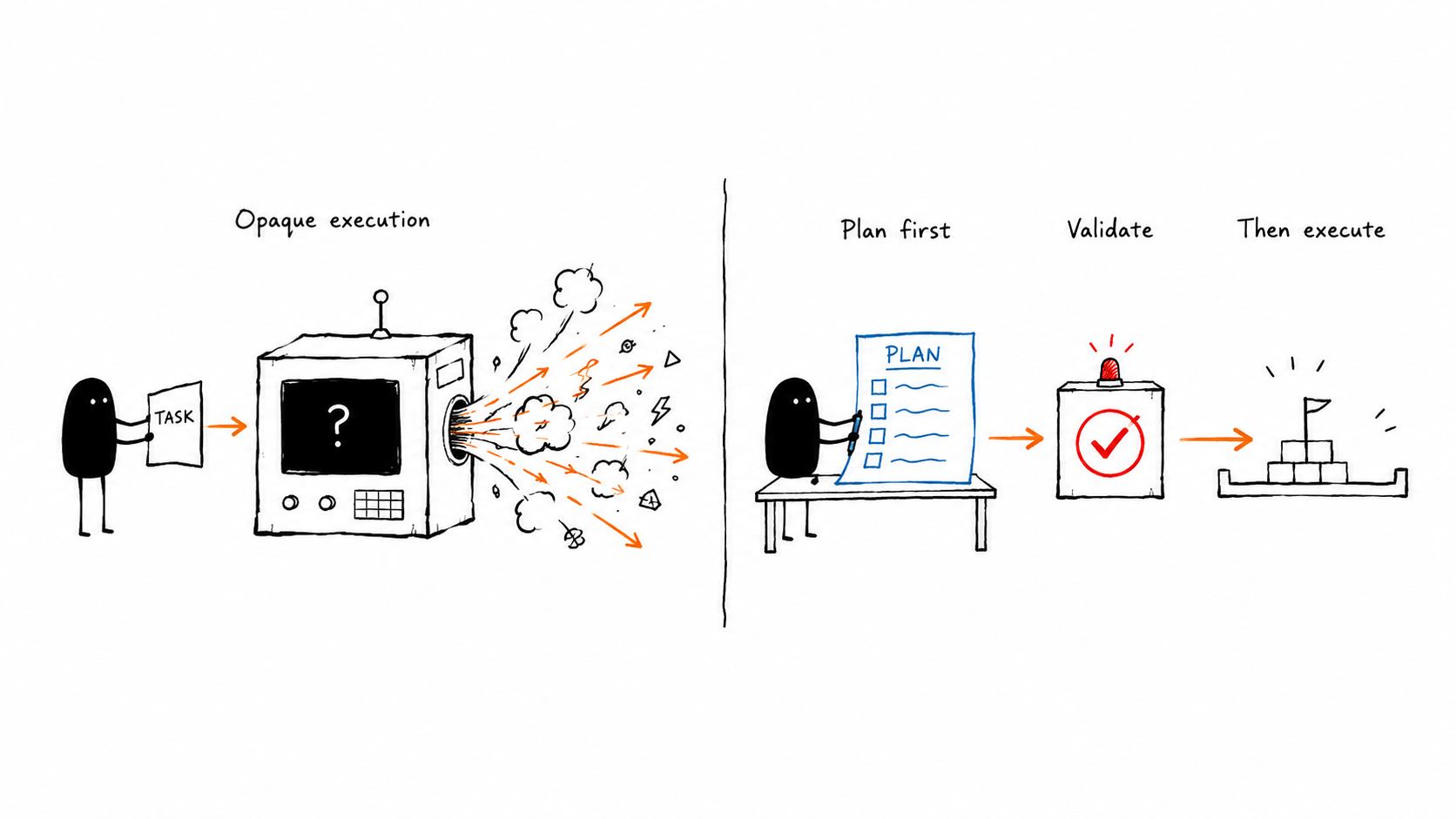
GH-600 Domain 1 explicitly tests one design decision here: keep planning distinct from execution. An agent should be able to produce a structured plan you can inspect and approve before it touches anything. Mixing “decide” and “do” into one opaque step is the anti-pattern the exam wants you to recognize and prevent.
Scenario. You ask an agent to “fix the failing test.” A bad design lets it immediately rewrite the test to pass — making the suite green and the bug invisible. A good design makes it output a plan first (“diagnose root cause → reproduce → fix source, not test → re-run”), which a human or a rule can validate before execution. Same model, same prompt — the architecture is what prevents the harmful action.
Where agents fit in the SDLC
The SDLC is the exam’s home turf. Map agent work to the stages you already know:
| SDLC stage | Agentic task example | Control that matters |
|---|---|---|
| Plan / triage | Turn an issue into a structured implementation plan | Plan is inspectable before code starts |
| Implement | Make changes on a branch | Branch scope, no direct push to main |
| Review | Summarize a diff, suggest fixes, run scans | Human still owns merge decision |
| Test / CI | Run tests, linters, security scans in CI | Agent invoked inside a workflow, sandboxed |
| Release | Prepare release notes, dependency bumps | Irreversible steps require explicit approval |
| Operate | Respond to alerts, open remediation PRs | Escalation path when confidence is low |
The recurring theme: the agent does the work, but GitHub’s existing controls — branches, required reviews, protected branches, CI gates — stay in force. You are not inventing new governance. You are pointing the agent through the controls you already trust.
Inputs, outputs, success criteria
Domain 1 lists this as a discrete skill: define inputs, outputs, and success criteria for agents. Treat every agent task like a function signature:
- Inputs — the issue, the repo scope, the constraints, the allowed tools.
- Outputs — a PR, a plan, a report, a passing build.
- Success criteria — measurable and pre-stated. “Tests pass and no new high-severity scan findings” beats “looks done.”
If you cannot state the success criterion before the agent runs, you cannot evaluate it afterward (that gap is exactly what Domain 4 punishes).
Common anti-patterns to recognize
The exam asks you to identify and mitigate common anti-patterns. The high-frequency ones:
| Anti-pattern | Why it is dangerous | Mitigation |
|---|---|---|
| Action without a plan | No checkpoint, no inspectability | Require a structured plan first |
| Goal with no success criterion | Cannot evaluate or stop | Pre-state measurable outcomes |
| Unbounded scope | Agent edits anything, anywhere | Scope to a repo / branch / path |
| ”Reward hacking” the metric | Rewrites the test instead of the bug | Constrain what it may change |
| Silent autonomy | No artifacts, no audit trail | Force inspectable outputs in standard tooling |
| Over-approval | A human gate on every trivial step | Right-size approvals to real risk |
Note the last row — the exam rewards velocity with control, not control for its own sake. Blocking everything is as wrong as blocking nothing.
Degrees of autonomy
You will see “autonomy level” again in Domain 6, but plant the seed now. Autonomy is a dial, not a switch:
- Suggest — agent proposes, human does everything.
- Act-with-approval — agent acts, but irreversible/sensitive steps need a human yes.
- Act-and-report — agent acts within a safe scope, produces artifacts, human reviews after.
- Autonomous — agent acts within hard guardrails, human only on exceptions.
The right level is per action, scored by risk — not per agent. Reading a file is low risk; force-pushing to main or rotating a secret is not. Right-sizing that dial without killing delivery speed is the judgment GH-600 keeps testing.
Exam-style check
Q1. An agent is asked to resolve a failing CI check and immediately edits the assertion so the test passes. Which design principle was violated?
A. Separation of planning from execution / preventing action until a plan is checked. The agent acted before producing an inspectable plan, enabling reward-hacking of the success signal. Fix: require a validated plan, and constrain which files the agent may modify.
Q2. Which is the better control for an agent that opens pull requests on a protected repo?
A. Let the agent work on a branch and open a PR that still goes through existing required reviews and checks — rather than granting it direct merge rights. Reuse the SDLC controls you already trust.
Q3. True or false: the safest configuration requires human approval on every agent action.
A. False. The exam rewards right-sized approvals. Gating trivial, reversible, low-risk actions destroys the velocity that justifies the agent — reserve human checkpoints for high blast-radius or irreversible steps.
What to memorize
- Assistant responds; agent acts — and acting is what triggers accountability questions.
- Keep planning separate from execution; make plans inspectable and approvable.
- Reuse existing GitHub SDLC controls; don’t invent parallel governance.
- Every agent task = inputs + outputs + a pre-stated, measurable success criterion.
- Autonomy is per-action and risk-scored; right-size approvals, don’t maximize them.
Next: how GitHub itself becomes the control plane — the Copilot coding agent, custom agents, and MCP.