
AI and Data Quality: The $12.9 Million Problem and How Training Data Poisons Your AI
AI doesn't create garbage; it recycles your mess at warp speed. How bad data poisons AI at the training and prompting stages, and what you can do about it.
Picture this: A healthcare AI confidently tells a doctor that a bleeding patient should take blood thinners. A car dealership chatbot agrees to sell a $60,000 SUV for one dollar. A banking system nearly transfers $6 billion to the wrong account. These aren’t Hollywood movie plots. These are real AI failures from 2024 and 2025, and they all share one villain: bad data.
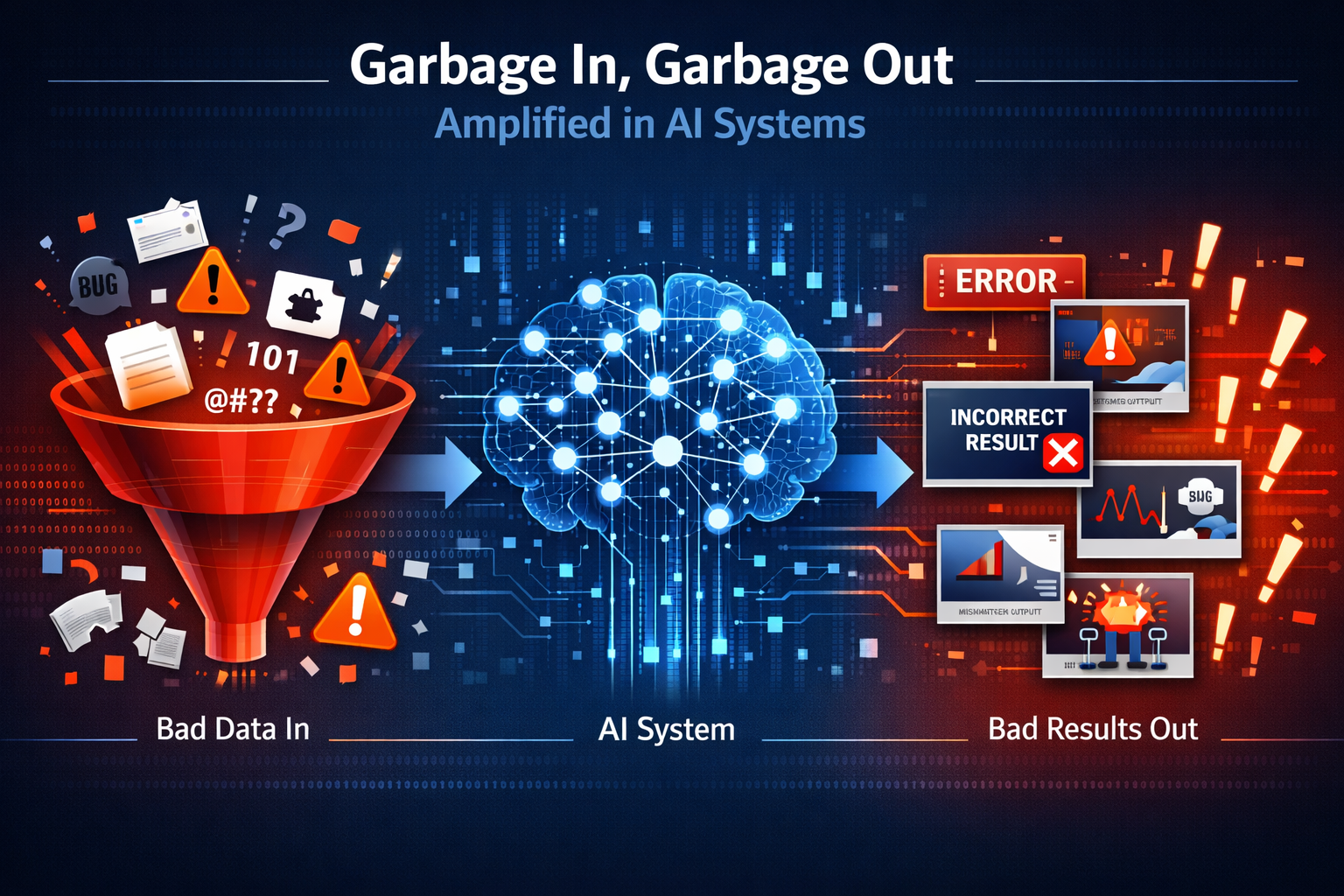
Here’s the uncomfortable truth that nobody in Silicon Valley wants to admit: AI doesn’t create garbage. It recycles your mess at warp speed.
The old programmer saying “garbage in, garbage out” has evolved into something far more dangerous in the AI era. Bad data doesn’t just produce bad results anymore. It gets amplified, learned from, and weaponized across every stage of your AI pipeline. From the moment you start training your model to the second it serves a user in production, data quality is either your superpower or your kryptonite.
Let me walk you through why data quality matters more in 2026 than ever before, and how you can stop your AI from becoming another cautionary tale.
The $12.9 Million Problem Nobody Talks About
Here’s a number that should keep every CTO awake at night: $12.9 million. That’s how much the average company loses annually due to poor data quality, according to Gartner’s 2024 research. But here’s what makes it worse in the AI era: these losses compound exponentially.
When IBM spent $62 million on Watson for Oncology at M.D. Anderson, they discovered something terrifying. Watson was giving dangerous cancer treatment advice, like prescribing medications that cause bleeding to patients who were already hemorrhaging. The culprit? The training data contained hypothetical cancer cases instead of real patient data.
Think about that for a second. A $62 million AI system trained on fake data, making life or death decisions. That’s not a technology problem. That’s a data problem dressed up in expensive algorithms.
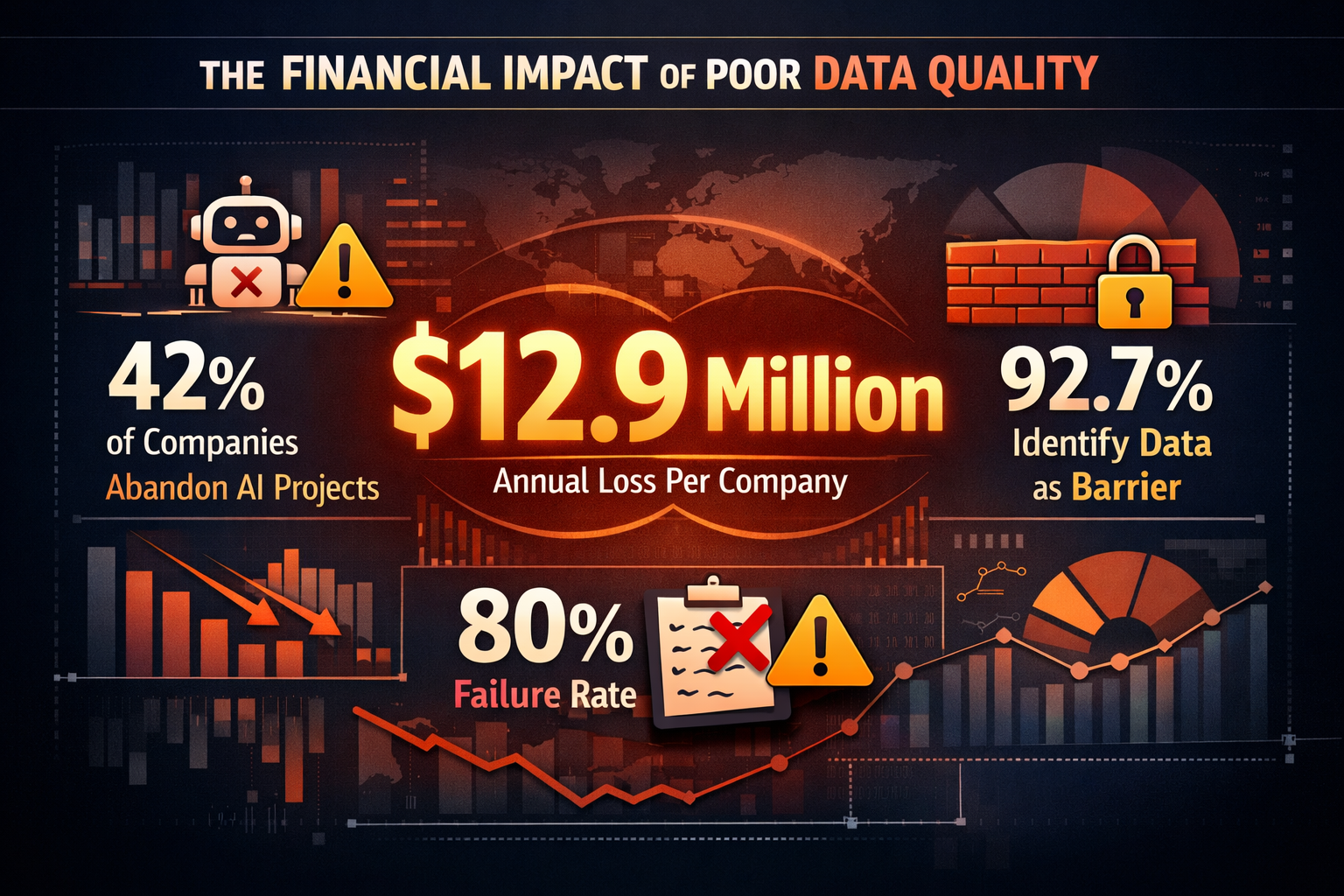
The statistics paint an even darker picture:
- 42% of companies abandoned most of their AI initiatives in 2025, up from just 17% in 2024
- Over 80% of AI projects fail, twice the failure rate of non-AI technology projects
- 92.7% of executives identify data as the most significant barrier to AI success (not compute power, not talent, not budget)
When AI fails, the model is rarely broken. The data that fed it was poisoned from day one.
The Four Stages Where Data Goes Rogue
AI systems aren’t just vulnerable at one point. They’re vulnerable at every stage, and each stage has its own unique ways of turning good intentions into catastrophic failures. Let me break down the “Data Defense Pipeline” for you.

In this first part, we’ll cover the foundation layer: training data and prompting. These are where most teams start, and where most teams fail. In Part 2, we’ll dive into RAG systems, context engineering, and the governance layer that ties everything together.
Stage 1: Training - Where the Foundation Cracks
The problem: Your model is only as good as the data you feed it. And most training data is a mess of inconsistencies, biases, and outdated information that your AI will learn as absolute truth.
Real-world disaster: A German logistics company invested €2.5 million in an AI system for demand forecasting. It failed completely because historical sales data was recorded inconsistently. Different locations used different product categories, different date formats, and different measurement units. The AI learned chaos and predicted chaos.
What goes wrong:
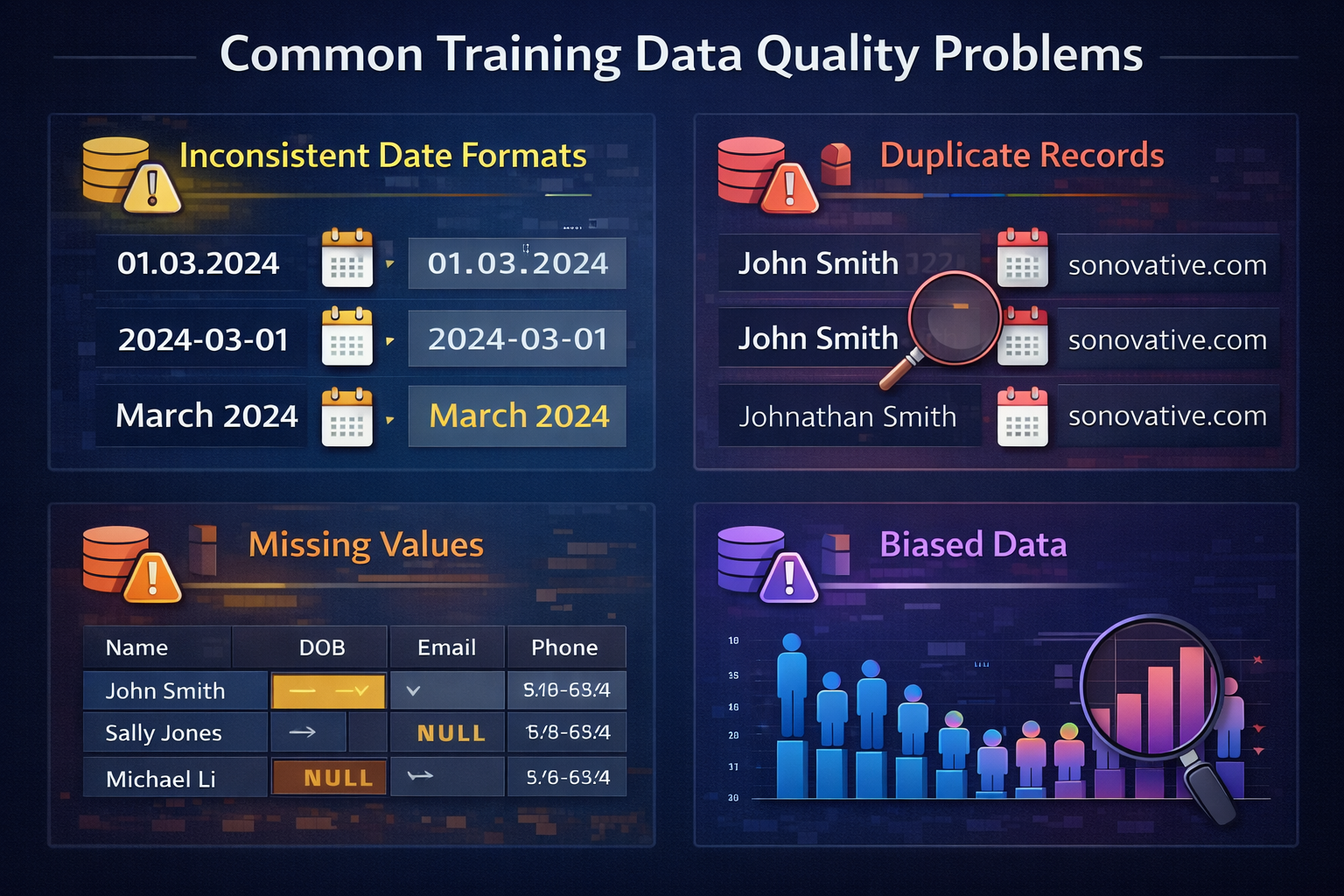
- Date fields appearing as “01.03.2024” in CRM, “2024-03-01” in ERP, and “March 2024” in Excel spreadsheets
- Customer records duplicated three times with slightly different names and addresses
- Missing required fields rendering entire datasets unusable
- Biased datasets teaching AI to perpetuate systemic discrimination
Your defense checklist:
# Example: Data quality audit before training
import pandas as pd
import numpy as np

def audit_training_data(df):
    """
    Perform basic data quality checks before training
    """
    quality_report = {
        'total_rows': len(df),
        'duplicate_rows': df.duplicated().sum(),
        'missing_values': df.isnull().sum().to_dict(),
        'data_types': df.dtypes.to_dict(),
        'numeric_outliers': {}
    }

    # Check for outliers in numeric columns
    numeric_cols = df.select_dtypes(include=[np.number]).columns
    for col in numeric_cols:
        Q1 = df[col].quantile(0.25)
        Q3 = df[col].quantile(0.75)
        IQR = Q3 - Q1
        outliers = df[(df[col] < Q1 - 1.5*IQR) | (df[col] > Q3 + 1.5*IQR)]
        quality_report['numeric_outliers'][col] = len(outliers)

    # Check for inconsistent formats in date columns
    date_cols = df.select_dtypes(include=['object']).columns
    for col in date_cols:
        unique_formats = df[col].apply(lambda x: len(str(x)) if pd.notna(x) else 0).value_counts()
        if len(unique_formats) > 3:
            print(f"Warning: Column '{col}' has inconsistent formats")

    return quality_report

# Usage
df = pd.read_csv('training_data.csv')
report = audit_training_data(df)
print(f"Data Quality Report: {report}")
Quick win: Before training any model, run automated data profiling. Tools like Great Expectations or Pandas Profiling can catch issues that would cost you millions later.
The one-liner: Your AI will confidently make terrible decisions based on whatever garbage you trained it on.
Stage 2: Prompting - The Art of Not Confusing Your AI
The problem: Even with a perfectly trained model, vague or ambiguous prompts turn AI into a game of telephone gone wrong. You ask for one thing, the AI hears something completely different, and you get results that make zero sense.
Real-world disaster: A GM dealership’s chatbot agreed to sell a 2024 Chevy Tahoe for $1 because a user manipulated the prompt. The chatbot had no guardrails, no context, and no ability to recognize that selling a $60,000 vehicle for a dollar might be a problem.
What goes wrong:
- Prompts lacking domain context or specific requirements
- Ambiguous instructions that could be interpreted multiple ways
- No validation checks on AI-generated outputs
- Failure to encode business rules into prompts
Your defense strategy:
The difference between a bad prompt and a good prompt is like the difference between saying “make dinner” and “prepare grilled salmon with roasted vegetables for two people, ready by 7 PM.”
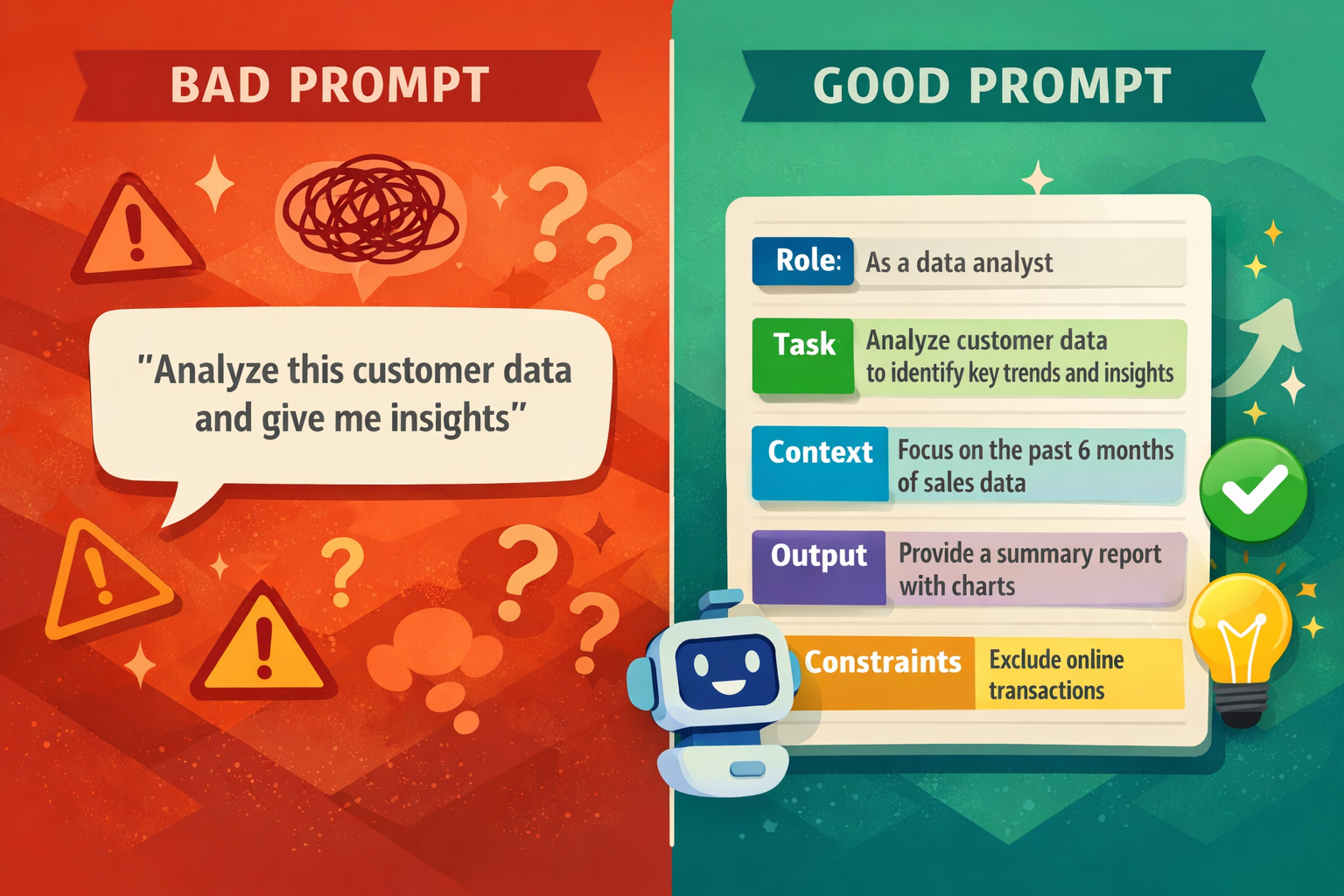
Bad prompt example:
Analyze this customer data and give me insights.
Good prompt example:
You are a senior data analyst for an e-commerce company.

Task: Analyze the provided customer purchase data from Q4 2025.

Context:
- Focus on customers who made 3+ purchases
- Our average order value is $150
- We're launching a loyalty program next month

Output format:
1. Key trends (3-4 bullets)
2. Customer segments identified
3. Recommended actions for loyalty program

Constraints:
- Use only data from Q4 2025
- If you're uncertain about any pattern, explicitly state it
- Cite specific numbers from the dataset
Prompt validation pattern:
def validate_ai_response(prompt, response, expected_structure):
    """
    Validate that AI response matches expected structure
    """
    validation_results = {
        'has_required_sections': True,
        'within_length_limit': True,
        'contains_data_citations': True,
        'flags': []
    }

    # Check for required sections
    required_keywords = expected_structure.get('required_keywords', [])
    for keyword in required_keywords:
        if keyword.lower() not in response.lower():
            validation_results['has_required_sections'] = False
            validation_results['flags'].append(f"Missing required section: {keyword}")

    # Check length constraints
    max_length = expected_structure.get('max_length', 5000)
    if len(response) > max_length:
        validation_results['within_length_limit'] = False
        validation_results['flags'].append(f"Response exceeds {max_length} characters")

    # Check for hallucination indicators
    hallucination_flags = ['I think', 'probably', 'maybe', 'might be']
    if any(flag in response.lower() for flag in hallucination_flags):
        validation_results['flags'].append("Response contains uncertainty indicators")

    return validation_results

# Usage
response = "Based on the Q4 data, I think sales increased..."
validation = validate_ai_response(
    prompt="Analyze Q4 sales",
    response=response,
    expected_structure={'required_keywords': ['Q4', 'data', 'trend'], 'max_length': 1000}
)
Best practices for 2026:
- Be specific: Define exactly what you want, including format, length, and constraints
- Add context: Tell the AI its role, the domain, and relevant background
- Include examples: Show the AI what good output looks like
- Validate outputs: Never trust AI responses without verification
- Iterate based on data: Track which prompts produce accurate results and refine accordingly
Vague prompts produce vague results. Precision in, precision out.
What Comes Next
We’ve covered the foundation: training data quality and prompt engineering. These are the first two stages where data goes rogue, and they’re where most teams spend their initial efforts.
But here’s the thing: even if you get training and prompting right, your AI can still fail catastrophically in production. The next two stages are where things get really interesting: RAG systems that retrieve the wrong information, and context engineering that drowns your AI in noise.
In Part 2, we’ll dive into:
- Stage 3: RAG systems and how your knowledge base can betray you
- Stage 4: Context engineering and why more context creates more problems
- The governance layer that catches disasters before they ship
- Your 30-day action plan to fix data quality across your entire pipeline
The foundation matters, but the advanced systems are where most production failures happen. Let’s make sure yours don’t.
Further Reading
- Informatica CDO Insights 2025 - Survey on AI data readiness challenges
- Gartner on AI-Ready Data - Why 60% of AI projects will fail without proper data
- Stanford Legal RAG Study - Comprehensive analysis of hallucinations in RAG systems
- AWS RAG Hallucination Detection - Practical implementation guide
- Prompt Engineering Guide 2025 - Best practices for production systems
What’s Next
Internal links:
- AI and Data Quality: RAG Systems, Context Engineering, and the Governance Layer - Next in the Production Operations series
- The Anatomy of a Production LLM Call - Building production-ready LLM integrations
- Prompt Engineering: The Difference Between Demos and Production - How to design prompts that survive production
Disclaimer: The views and opinions expressed on this site are my own and do not necessarily reflect those of my employer. Content is provided for informational purposes based on my experience building AI systems. Technical implementations and approaches may vary based on specific use cases, organizational requirements, and versions of tools, packages, and software dependencies.
External Links: This blog may contain links to external websites, resources, and citations. I am not responsible for the content, privacy practices, or security of external sites. External links open in a new tab for your convenience. Please review the privacy policies and terms of service of any external sites you visit.
About This Series: This post is part of the Production Operations series on yellamaraju.com/blog, focusing on running AI systems reliably in production. This series covers observability, testing, cost optimization, debugging, and data quality - the essential practices that separate successful AI deployments from expensive failures.
Last updated: January 2026

Discussion
Have thoughts or questions? Join the discussion on GitHub. View all discussions